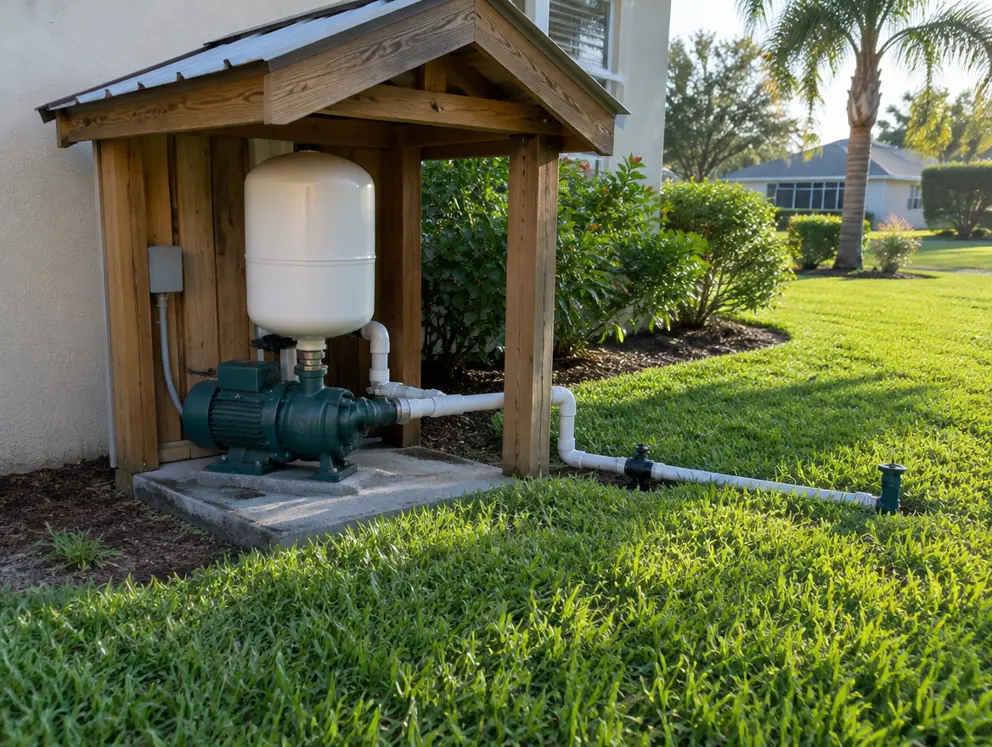
A jet pump sits above ground, usually beside the house or under a small pump-house roof, and pulls water up from a shallow well. It's the standard setup for sprinkler wells in Titusville and Port St. John, and for some older household wells. Easy to reach. Easy to lose prime.
Call (321) 220-9883What goes wrong
- Lost prime. The pump runs but moves no water. An air leak on the suction side or a failed foot valve is the usual cause.
- Humming but not turning. Often a failed start capacitor or a seized motor. Switch it off at the breaker so it doesn't overheat.
- Water dripping from the pump. A worn shaft seal. Fix it before water reaches the motor bearings.
- Weak sprinklers. A clogged impeller or jet, a dirty strainer, or a falling water table in a dry spring.
- Screeching or grinding. Motor bearings on their way out.
Try this first
If there's a strainer basket on the pump, turn it off and clean the basket. If the pump has lost prime after sitting through the rainy season, refilling the priming port can bring it back. If it won't hold prime, there's a leak, and that's a job for the contractor.
What a repair covers
- Finding and sealing suction leaks.
- Replacing foot valves, check valves, seals, impellers and capacitors.
- Testing the motor and pressure switch.
- Replacing the pump when the motor is gone, sized to the well and the zones it feeds.
Common questions
Why does my jet pump keep losing prime?
Almost always an air leak on the suction side or a foot valve that no longer holds. Both can be found and fixed.
Can a jet pump be repaired or must it be replaced?
Seals, impellers, capacitors and valves can all be replaced. If the motor is burnt out, a new pump is usually better value.
Is a jet pump right for my household well?
Only if the well is shallow. Deeper wells need a submersible pump. A contractor can tell you which you have.